Areca Leaf Plate Manufacturing Project Report: 2025 Business Guide
The Areca leaf plate manufacturing project is a highly feasible, eco-friendly business venture with significant profitability in 2025. This project report outlines the essential components—from technical setup to financial projections—required to establish a successful unit in India.
1. Executive Summary: The Business Opportunity
With the global shift toward “Zero-Waste” and the strict enforcement of plastic bans in India and the West, areca palm leaf plates (Pakku Mattai) have become a premium substitute. This business utilizes agricultural waste (fallen sheaths) to create 100% biodegradable and compostable dinnerware.
2. Market Analysis & Potential
- Demand: Growing at a CAGR of 8-10%, fueled by eco-conscious catering, organic restaurants, and a booming export market in the USA, Europe, and Australia.
- Target Market: Event planners, temple trusts, wholesale distributors, and international sustainable product retailers.
3. Technical Specifications
To set up a standard unit with a production capacity of roughly 2,000–4,000 plates per day, the following infrastructure is required:
- Land & Building: 1,200 to 2,000 sq. ft. area for raw material storage, production, and finished goods.
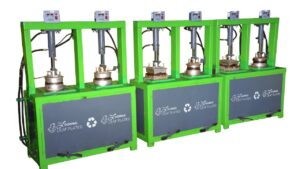
- Machinery: Semi-automatic or fully automatic hydraulic machines (3-die to 6-die), high-pressure washing units, and UV-sterilization equipment.
- Power Requirement: Approximately 5 HP to 8 HP of connected load.
- Manpower: 4 to 8 workers (skilled operators and unskilled cleaners/packers).
4. Financial Projections (Estimated)
| Component | Estimated Cost (INR) |
| Machinery & Equipment | ₹4,50,000 – ₹8,00,000 |
| Working Capital (1 Cycle) | ₹2,00,000 – ₹3,50,000 |
| Total Project Cost | ₹7,00,000 – ₹12,00,000 |
| Expected Net Profit Margin | 20% to 25% |
| Payback Period | 3 to 4 years |
Note: Large-scale export-oriented units may require an investment of ₹25 lakhs to ₹50 lakhs.
5. Government Subsidies & Funding
In 2025, this project is eligible for significant support under the Prime Minister’s Employment Generation Programme (PMEGP) and MSME schemes:
- Subsidy: 15% to 35% of the total project cost depending on location (Urban vs. Rural) and social category.
- Promoter Contribution: Only 5% to 10% of the project cost.
- Loans: Term loans and working capital from nationalized banks are facilitated through KVIC (Khadi and Village Industries Commission).
6. Conclusion
The areca leaf plate manufacturing project is not just a commercial success but a socially responsible “Rural Revolution” that converts waste into wealth while providing local employment.