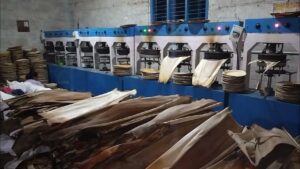
The Future of Sustainable Tableware: Areca Plate Manufacturing
Areca plate manufacturing has emerged as one of the most promising “green” industries, offering a $100\%$ biodegradable and compostable alternative to plastic and Styrofoam. Utilizing the naturally shed sheaths of the Areca palm tree (Areca catechu), this manufacturing process transforms agricultural waste into premium, eco-friendly dinnerware that is in high demand across global markets.
The Lifecycle of an Areca Plate: Step-by-Step
The beauty of areca plate manufacturing lies in its simplicity and lack of chemical additives. The process generally follows these essential stages:
- Sourcing and Collection: The raw material—the palm sheath—is collected from Areca plantations. Since the sheaths fall naturally, no trees are cut during this process, making it a truly regenerative industry.
- Cleaning and Conditioning: The collected sheaths are thoroughly washed with high-pressure water jets to remove dust and impurities. They are then briefly soaked to make the fibers pliable for molding.
- Thermal Molding (The Core Process): The moist sheath is placed into an Areca plate making machine. Using a combination of hydraulic pressure and heat (between $100^{\circ}\text{C}$ and $150^{\circ}\text{C}$), the machine compresses the leaf into the desired shape. This heat also serves as a natural sterilization process.
- Trimming and Finishing: Once molded, the plates are trimmed to remove excess edges. They are then cleaned with a brush, UV-sterilized, and moisture-tested to ensure a long shelf life.
- Packaging: Finally, the plates are shrink-wrapped in sets to prevent moisture absorption before being shipped to domestic or international buyers.
Why Areca Plate Manufacturing is a Winning Business
- Eco-Friendly Credentials: Unlike paper plates, Areca plates require no wood pulp. Unlike plastic, they decompose naturally within 60 to 90 days in a backyard compost bin.
- Superior Quality: The natural texture of the palm leaf makes the plates sturdy, leak-proof, and heat-resistant. They can hold hot liquids and are microwave-safe.
- Low Capital Investment: This is an ideal business for MSMEs (Micro, Small, and Medium Enterprises). With a relatively low setup cost for machinery, entrepreneurs can start small and scale up as demand grows.
- High Export Potential: There is a massive demand for sustainable tableware in Europe, North America, and Australia, where plastic bans are becoming strictly enforced.
Areca plate manufacturing is more than just a business; it is a step toward a circular economy that empowers rural farmers and protects the planet.